
What a Corrections Sergeant Told Me Every Rookie Needs to Know
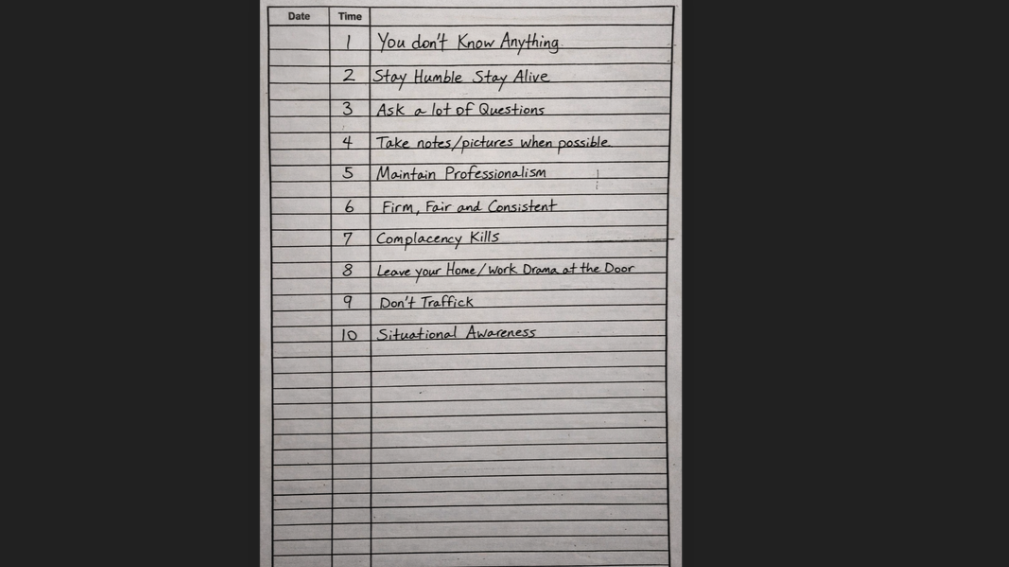
A guide a real corrections Sargent shared with me for rookies.
There’s a difference between what you’re taught in corrections training and what actually keeps you safe on the job.
Recently, a corrections sergeant shared a handwritten guide with me for rookies. It wasn’t formal. It wasn’t something you’d find in a handbook. But it was real and every line came from experience.
I want to break it down, because this is the kind of advice people usually learn the hard way.
1. “You don’t know anything”
This isn’t disrespect, it’s mindset.
The moment you walk into a jail or prison thinking you’ve got it figured out is when you become a liability. Staying teachable keeps you safe.
2. Stay humble. Stay alive.
Ego will get you tested fast.
Respect, awareness, and how you carry yourself matter more than trying to prove something.
3. Ask a lot of questions
The officers who struggle the most are usually the ones who stay quiet.
If you don’t know something, ask. That’s how you learn the environment, the inmates, and the expectations.
4. Take notes when possible
There’s too much information to rely on memory alone.
Names, routines, behaviors, it all matters. The officers who pay attention are the ones who stay ahead.
5. Maintain professionalism
No matter what’s going on, attitude, stress, or chaos, your professionalism is your control.
Once you lose that, situations escalate fast.
6. Be firm, fair, and consistent
Inmates watch everything.
If you’re inconsistent, they’ll find it. If you’re unfair, they won’t respect you. If you’re not firm, they’ll test you.
Balance is everything.
7. Complacency kills
The job can feel repetitive, but that’s where people slip.
The moment you get too comfortable is when mistakes happen.
8. Leave personal and work drama at the door
Distractions in the jail and prison environment are dangerous.
When you’re inside, your focus has to be on what’s happening around you, not what’s going on outside.
9. Don’t traffic
This one doesn’t need a long explanation.
It’s not worth your career, your record, or your future. And when things go wrong, no one, especially not the inmate, is going to save you.
10. Situational awareness
This is everything.
Pay attention to movement, tone, behavior, patterns. What you don’t notice can hurt you.
Final Thoughts
What stood out to me about this list is how simple it is.
No complicated theories. No textbook language.
Just real advice from someone who’s been in the environment and understands what it actually takes to make it.
If you’re thinking about working in corrections, or you’re just starting, this is the kind of guidance you should pay attention to.
