
What a Corrections Sergeant Told Me Every Rookie Needs to Know
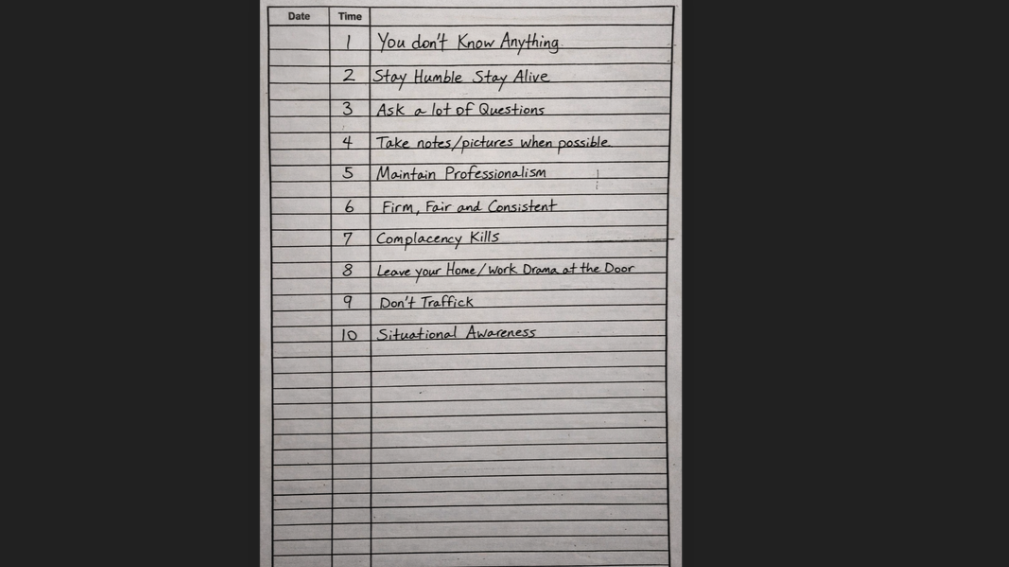
A guide a real corrections Sargent shared with me for rookies.
There’s a difference between what you’re taught in corrections training and what actually keeps you safe on the job.
Recently, a corrections sergeant shared a handwritten guide with me for rookies. It wasn’t formal. It wasn’t something you’d find in a handbook. But it was real and every line came from experience.
I want to break it down, because this is the kind of advice people usually learn the hard way.
1. “You don’t know anything”
This isn’t disrespect, it’s mindset.
The moment you walk into a jail or prison thinking you’ve got it figured out is when you become a liability. Staying teachable keeps you safe.
2. Stay humble. Stay alive.
Ego will get you tested fast.
Respect, awareness, and how you carry yourself matter more than trying to prove something.
3. Ask a lot of questions
The officers who struggle the most are usually the ones who stay quiet.
If you don’t know something, ask. That’s how you learn the environment, the inmates, and the expectations.
4. Take notes when possible
There’s too much information to rely on memory alone.
Names, routines, behaviors, it all matters. The officers who pay attention are the ones who stay ahead.
5. Maintain professionalism
No matter what’s going on, attitude, stress, or chaos, your professionalism is your control.
Once you lose that, situations escalate fast.
6. Be firm, fair, and consistent
Inmates watch everything.
If you’re inconsistent, they’ll find it. If you’re unfair, they won’t respect you. If you’re not firm, they’ll test you.
Balance is everything.
7. Complacency kills
The job can feel repetitive, but that’s where people slip.
The moment you get too comfortable is when mistakes happen.
8. Leave personal and work drama at the door
Distractions in the jail and prison environment are dangerous.
When you’re inside, your focus has to be on what’s happening around you, not what’s going on outside.
9. Don’t traffic
This one doesn’t need a long explanation.
It’s not worth your career, your record, or your future. And when things go wrong, no one, especially not the inmate, is going to save you.
10. Situational awareness
This is everything.
Pay attention to movement, tone, behavior, patterns. What you don’t notice can hurt you.
Final Thoughts
What stood out to me about this list is how simple it is.
No complicated theories. No textbook language.
Just real advice from someone who’s been in the environment and understands what it actually takes to make it.
If you’re thinking about working in corrections, or you’re just starting, this is the kind of guidance you should pay attention to.
Why “Andy’s Law” Should Set the Standard for Officer Protection in Ohio

Inside a correctional facility, where staff safety directly impacts operational stability.
In corrections, safety isn’t optional—it’s foundational.
From my experience working with federal inmates through the U.S. Marshals and across multiple facilities, one thing becomes clear quickly: when staff safety is compromised, the entire facility becomes unstable.
That’s why House Bill 338—commonly referred to as “Andy’s Law”—deserves serious attention.
Named in honor of Officer Andrew Clark, this legislation proposes a mandatory 7-year consecutive sentence for individuals who assault corrections staff. The emphasis on consecutive sentencing is what makes this bill significant.
Real-World Impact
During the time of the Andy Clark incident, I was working at a federal facility in Northeast Ohio supporting U.S. Marshals operations.
Incidents like that don’t just impact one officer—they shift the entire atmosphere of a facility.
Staff become more alert. Tension rises. The reality of the risks becomes more immediate, not just understood.
That shift in atmosphere is something people outside the system rarely see—but it affects everything.
The Reality Inside Facilities
Corrections professionals operate in environments that are unpredictable, high-risk, and often misunderstood.
While risk is part of the job, lack of accountability should not be.
In many cases, additional time for assaults is served concurrently—meaning it does not meaningfully impact individuals already serving long sentences. As a result, the deterrent effect is limited.
Why Consecutive Sentencing Matters
A mandatory consecutive sentence changes that dynamic.
It creates:
A clear and enforceable consequence
A stronger deterrent against assaults
A shift in how safety is maintained within housing units
This isn’t about punishment for the sake of punishment—it’s about establishing boundaries that protect staff and maintain order.
From a practical standpoint, policies like this send a necessary message:
Staff safety is non-negotiable.
Corrections officers are responsible for maintaining structure in environments that can quickly become volatile. Without consistent consequences for violence against staff, that structure weakens.
Protecting corrections professionals is not a political issue—it’s a workplace safety issue.
Ohio has an opportunity to lead by example with legislation like this.
For those currently working in corrections:
From the Front Lines to Policy Reform: Why Ohio’s Move on Inmate Hygiene is Long Overdue

Incarcerated women in a housing unit during supervised dayroom time.
Throughout my career, from serving as a jail deputy for the Pennsylvania DOC to managing State of Ohio and US Marshal inmates in the federal system, I have seen how facility policy directly impacts unit stability. One issue I encountered consistently was the lack of standardized, free access to feminine hygiene products to female inmates. I disagreed with that approach then, and I am encouraged to see Ohio take a leadership role in correcting it now.
With the recent enactment of House Bill 29, Ohio has established a new baseline for correctional standards. The law mandates:
Standardized Access: All municipal, county, and state facilities must provide hygiene products at no cost.
Operational Dignity: Guarantees access to a daily hot shower for those on their cycle, even in restrictive housing.
Policy Integrity: Prohibits these items from being used as disciplinary leverage or "privileges."
The Professional Perspective: In corrections, our primary mission is Care, Custody, and Control. In my experience, when we allow an "underground economy" to form over basic necessities, we compromise all three. Removing these stressors doesn't just benefit the inmate population; it creates a more predictable, safer environment for the officers working the floor.
Professionalizing our standards is a proactive way to reduce tension and focus our resources on high-level security and rehabilitation.
To my colleagues in Ohio Law Enforcement and Corrections: As these mandates take effect, what shifts are you seeing in facility climate or operational procedures?

Corrections, Compliance, and Constitutional Risk: Lessons from Recent Policy Discussions

Image source: WOSU Public Media (Northeast Ohio Correctional Facility)
In January of 2026, I had the privilege of attending a highly informative webinar today hosted by the American Jail Association and presented by LexisNexis.
The session, “Ensuring Constitutional Rights for the Incarcerated and Reducing Your Liability in Corrections 2025-2026,” featured Gerard Horgan, a 31-year corrections veteran and attorney. His insights into the intersection of facility operations and constitutional law were incredibly timely.
💡 Key Takeaways:
• Medical & Mental Health Care: We took a deep dive into the Opioid Use Disorder (OUD) and Fentanyl crisis. Cases like Spurlock v. Wexford highlight the critical need for proper MAT (Medication-Assisted Treatment) access and the legal risks of denying care to those in detox.
• Suicide Prevention: The statistics are sobering—26% of jail suicides occur within the first 72 hours. Identifying risk factors like "first incarceration" and "restrictive housing" is vital for early intervention.
• The Power of Documentation: Whether it's a Use-of-Force incident (Graham v. Connor) or medical screening, if it isn't documented, it didn't happen.
• Access to Courts & Technology: I was impressed by how LexisNexis is bridging the gap for incarcerated individuals who lack internet access, ensuring they can still exercise their rights.
• Reframing Grievances: A great perspective shift—grievances aren’t just "complaints"; they are opportunities to investigate issues and improve the facility before they escalate to litigation.
As regulations around the ADA and RLUIPA continue to evolve, staying proactive on compliance isn't just about reducing liability—it's about running a safer, more humane environment for everyone.
A big thank you to the AJA and LexisNexis for such a high-value session!
The Female Advantage in Law Enforcement: Strength, Strategy, and the Power of De-Escalation

Image Source: Story County Sheriff’s Office
In February of 2026, I spent some time today diving deep into the evolution of policing during a powerful webinar led by Dr. Pytal and Dr. Jean Kanokogi, PhD. The conversation wasn't just about "fitting in" to a male-dominated field; it was about the biological and tactical strengths that women bring to the front lines.
One quote from the session stood out and perfectly captured the essence of our role: “Women in law enforcement can talk a criminal into handcuffs.”
While we acknowledge the physical differences—such as the higher lung capacity and raw stamina often found in our male counterparts—the "Female Advantage" is a tactical reality that is often overlooked. We explored how women navigate law enforcement culture by leaning into our natural physiological and psychological strengths:
The Neurobiology of Stress: Research shows that women have more nerve cells in specific regions of the brain and produce higher levels of oxytocin under pressure. While adrenaline fuels the "fight," oxytocin helps us remain relational, allowing for clearer communication when things get heated.
Tactical Intuition: Our advantages in perception, agility, and maneuverability allow us to read a room and "defeat" stressors through de-escalation rather than just force.
Safety Through Strategy: Statistics show that female officers are named in fewer lawsuits and often experience fewer harmful events on the job. Why? Because we ask more questions and utilize a relational tone. Even the "criminal element" often lets their guard down, providing a window for safer, more controlled resolutions.
Perhaps the most striking statistic shared was that 70% of women in law enforcement struggle with Imposter Syndrome. Despite our high performance, many of us carry a persistent fear of failure or a sense of self-doubt.
Today was a vital reminder that these feelings don't stem from a lack of ability, but from navigating a culture that wasn't originally built for us. We learned that our differences aren't "weaknesses" to be hidden; they are our greatest tactical advantages.
When we lean into our intuition and our ability to build rapport, we aren't just doing the job—we are making the profession safer and more effective for everyone.